
Toxin-Free Baking Supplies (Without Going Broke)
Toxin-free baking supplies? Yes.
I’ve been on this non-toxic journey for over two decades, and at times I was forced to go full-throttle on swaps. That approach was stressful—financially, mentally, and emotionally—and I don’t want that for you.
So here’s your permission slip: make swaps within your budget. Shop thrift stores. Use Marketplace. Buy used when it makes sense. We did—and I have zero regrets.
This page isn’t about perfection. It’s about progress.
Plastic
Ironically, our first big swaps weren’t plastic—but if we wanted to save time and money, they probably should have been.
Whenever possible, I buy local and in glass. I’ve been burned more than once by “pretty” silicone-coated non-stick pans. The coating flaked off without any abrasive abuse, which told me everything I needed to know. You won’t find those pans in my kitchen.
Grain Mills
If you’re milling your own flour, the mill matters—but you don’t need the biggest or most expensive one unless you mill a lot.
I personally use the Mockmill 200 Professional, and I’ve milled over 10 pounds of grain in one go before it needed a cool-down rest. That said, most people do not need that capacity.
Before buying, learn the differences between stone, impact, and manual mills.
I break that down here: Which mill is best?
I’ve organized mill recommendations by type so you can choose what fits your needs and budget:
Grain Mills Stone
- KoMo Mills
- KoMo Mio
- Mockmill 100 my first mill, and still a fave
- Mockmill 200same as the 100, twice as fast
- Mockmill 200 Lino
- Mockmill Lino 100
- Mockmill Professional 200 best for large families or small bakeries
- Nutrimill Harvest choose from bamboo or walnut wood housing and a variety of accent colors.
Grain Mills Impact
- Nutrimill Classicgreat for milling a lot of flour at once
- Nutrimill Impact Grain Mill My favorite of the impact mills, and I've tried them all. Mills super fine flour, and is the most compact and easy to use.
- Wondermill Grain Mill
Grain Mills Manual
Grain Mills Flaker
Grain Mills Attachment
- Mockmill for KitchenAidgood for testing milling
High-Powered Blenders
Not all blenders can handle grain.
These did pass my testing:
Ninja and bullet-style blenders didn’t cut it for bread flour. They were fine for cornmeal-style textures, but not for fine flour.
Mixers
I’ve used a lot of mixers:
KitchenAid, WonderMix, Bosch Compact, Bosch Universal Plus, Ankarsrum, NutriMill Artiste, and two Zacme mixers (5-qt and 7-qt).
Here’s where I landed:
Zacme Mixers
The 5-quart will outperform a KitchenAid at half the price, but it’s louder than I like.
The 7-quart is quieter and my daily driver.
The 5-qt and 8-qt have bowl lights; the 7-qt does not.Most importantly: no plastic touching my food.
These mixers also have a pasta roller attachment, which makes pasta without plastic contact—other than going fully by hand, this is the cleanest option I’ve found.
Hands down, Zacme mixers are the best I’ve tested for kneading fresh-milled bread dough.
I still own the Ankarsrum and Bosch Universal Plus, and I’ll also recommend a vintage Sunbeam mixer if you can find one. It has true dough hooks and a real bread setting. It’s my #2 favorite mixer.
I’ve grouped mixer options here so you can compare:
Appliances Mixers
- Ankarsrum Mixer
- Bosch Universal PlusLarge capacityUse code JUSTMILLIT
- Nutrimill ArtisteUse code JUSTMILLIT
- Zacme 5 qt mixer
- Zacme 7 qt mixer
- Zacme 8 qt mixer
Baking Prep Tools
This is where glass, metal, and wood really shine.
You’ll find my recommended:
Utensils
Baking supplies
Grain storage options
When it comes to long-term food storage, plastic concerns take a back seat to food safety. I bought my grain buckets used and paired them with Lowe’s screw-top lids.
Utensils
- Balloon Whisk
- Chef Knife
- Silicone Pastry Brushes
- Silicone Spatulas
- Stainless steel magnetic measuring spoons
Baking Supplies
- Biscuit/Donut CutterI use this for my donuts and biscuits.
- Instant read digital thermometer
- Muffin Cupcake Liners
- Parchment sheets unbleached
- Pyrex Bowl set (with lids)
- Silicone bread slings
- Silicone Muffin / Cupcake Liners
- Stainless steel bench scraper
- Stainless steel food scale
- Waterproof rechargeable digital scale
Storage
Baking Appliances
Waffle makers: I use antique stovetop waffle irons—one Wagner and one Puritan.
For bakeware:
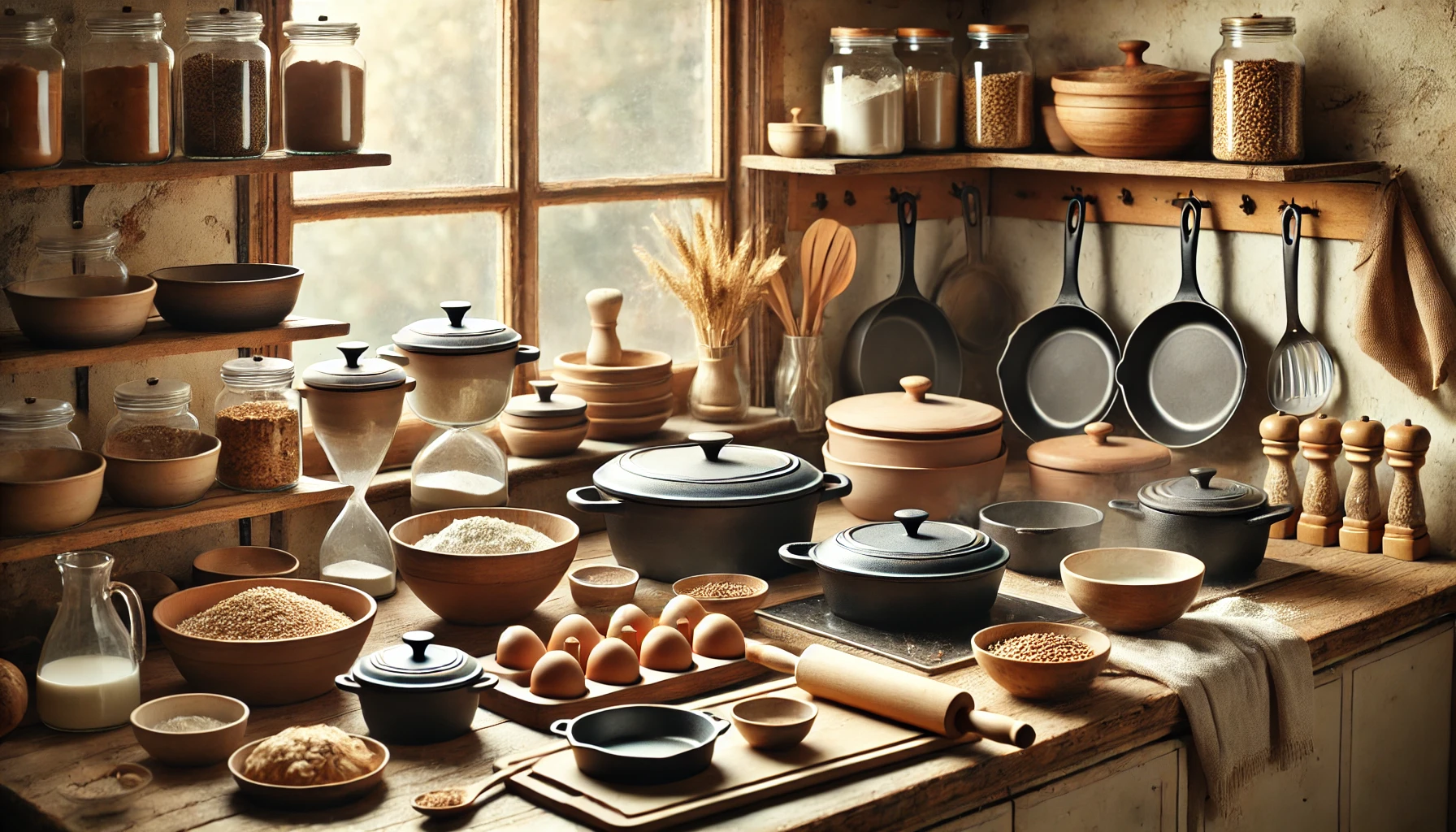
Cast iron baking sheets, pans, and dishes
Skillets (mine are Griswold and Wagner, passed down from my grandfather—any cast iron works)
Dutch ovens (I love my antique Wagner 2.5-qt with a Pyrex lid; Lodge makes a great modern option where the lid doubles as a skillet)
Appliances Baking Supplies
Cast Iron
- 9x13" Baking Pan
- Bakers Favorite Set (pie pan, casserole, cupcake and bread pan)
- Baking Pan 10" x 15"
- Lodge biscuit pan
- Lodge cast iron loaf pans
- Lodge Dutch oven / skillet
- Lodge muffin pans - set of 2 for 12 cupcakes
- Pie Pan, 9 inch
- Pizza Pan, 15"
Toxic — But Still in My Kitchen
Let’s be honest.
I still own the Philips Avance Pasta Extruder.
It has:
A plastic mixing chamber
A non-stick coated die
I use brass dies instead of plastic, but it’s still not toxin-free. That said, if you want bowtie, fusilli, or shaped pasta, this is currently the least-bad option I’ve found—especially when paired with organic, freshly milled grain.
We eliminated the chemicals in store-bought flour and added nutrition back in. That matters.
I won’t be getting rid of it until a truly affordable alternative exists.
You’ll always get full disclosure from me. I’m not here to pretend I’m perfect—I’m here to show what progress looks like, one kitchen tool at a time.
Of course the less toxic option would be to hand cut and roll the pasta yourself. There are attachments for that, or a rolling pin and some flour will suffice.
Pasta
- Artisan Whole Grain Pasta For when you don't want to Just Mill ItUse code Justmillit
- Philips Avance Pasta Extruder best home pasta extruder
- Philips Viva Compact Pasta Extruderbest for small counter footprint
- Zacme 3 in 1 Pasta Maker Attachment for Zacme Mixers
Grains
Fresh, whole grains are the foundation of everything here.
I’ve linked the grains I use and trust so you can start where it makes sense for you.
Grains
- Dakota Snow Hard White Wheat Berries Known for their maximum nutritionUse code Justmillit
- Durum wheat berries (not-organic)
- Hard Red Spring Wheat Berries Use code Justmillit
- Heritage Spelt Berries Use code Justmillit
- Organic barley
- Organic dent corn - great river milling
- Organic Einkhorn Wheat Berries
- Organic Einkhorn Wheat berries - grand teton
- Organic Emmer Grain - Grand teton
- Organic hard red wheat berries - central milling
- Organic hard white wheat - central milling
- Organic hard white wheat berries
- Organic Kamut (Khorasan) berries - Grand Teton
- Organic oat groats
- Organic popcorn kernels
- Organic rye grain - great river milling
- Organic soft white wheat berries
- Organic spelt grain - great river
- Rouge de Bordeaux Wheat Berries So delicious, high protein heirloom wheat, excellent for bread.Use code Justmillit
- Turkey Red WheatUse code Justmillit
Join our Online Community
Ready to ditch recipes and learn more about baking with fresh milled flour using methods and your imagination? Join my Fresh milled Flour Methods group. You can ask questions, share your wins, and more with an expectation of honesty and friendly interaction. I hear it’s the best place to be on Facebook.