
How Much Water Should Go Into Fresh Milled Bread Dough?
If you’re coming from baking with bagged flour, this part can feel uncomfortable at first — and that’s okay.
Most bread recipes written for commercial flour live in the 60–80% hydration range. When people switch to fresh milled flour, they often try to stay in that same zone… and end up with dough that feels stiff, tears easily, and never quite becomes what they hoped it would be.
Here’s the missing piece:
Fresh milled flour absorbs significantly more water than bagged flour.
Once you understand that, everything else starts to make sense.
Bagged Flour Hydration vs Fresh Milled Flour Hydration
Commercial all-purpose and bread flour typically absorb water at around 68% of the flour’s weight.
Fresh milled flour is different.
Because it still contains:
the bran
the germ
intact starches
…it continues absorbing water long after mixing begins.
In practical terms, that means:
Fresh milled hard wheat absorbs ~17% more water
Fresh milled soft wheat absorbs ~7% more water
So when you adjust for absorption, the numbers line up like this:
Bagged Flour Hydration | Fresh Milled Equivalent |
|---|---|
60% | ~77% |
65% | ~82% |
70% | ~87% |
75% | ~92% |
80% | ~97% |
That’s not “high hydration for the sake of it.”
That’s equivalent hydration.
Why Most Bakers Never Discover This
Two things usually get in the way:
1. Water isn’t adjusted enough
People often add “a splash more water” instead of accounting for absorption. The dough still looks dry — because it is dry.
2. Kneading stops too soon
Fresh milled dough takes longer to organize itself. Bran needs time to hydrate. Gluten needs time to align. If you stop early, you never see what the dough could become.
Hydration and kneading work together. You can’t fix one without the other.
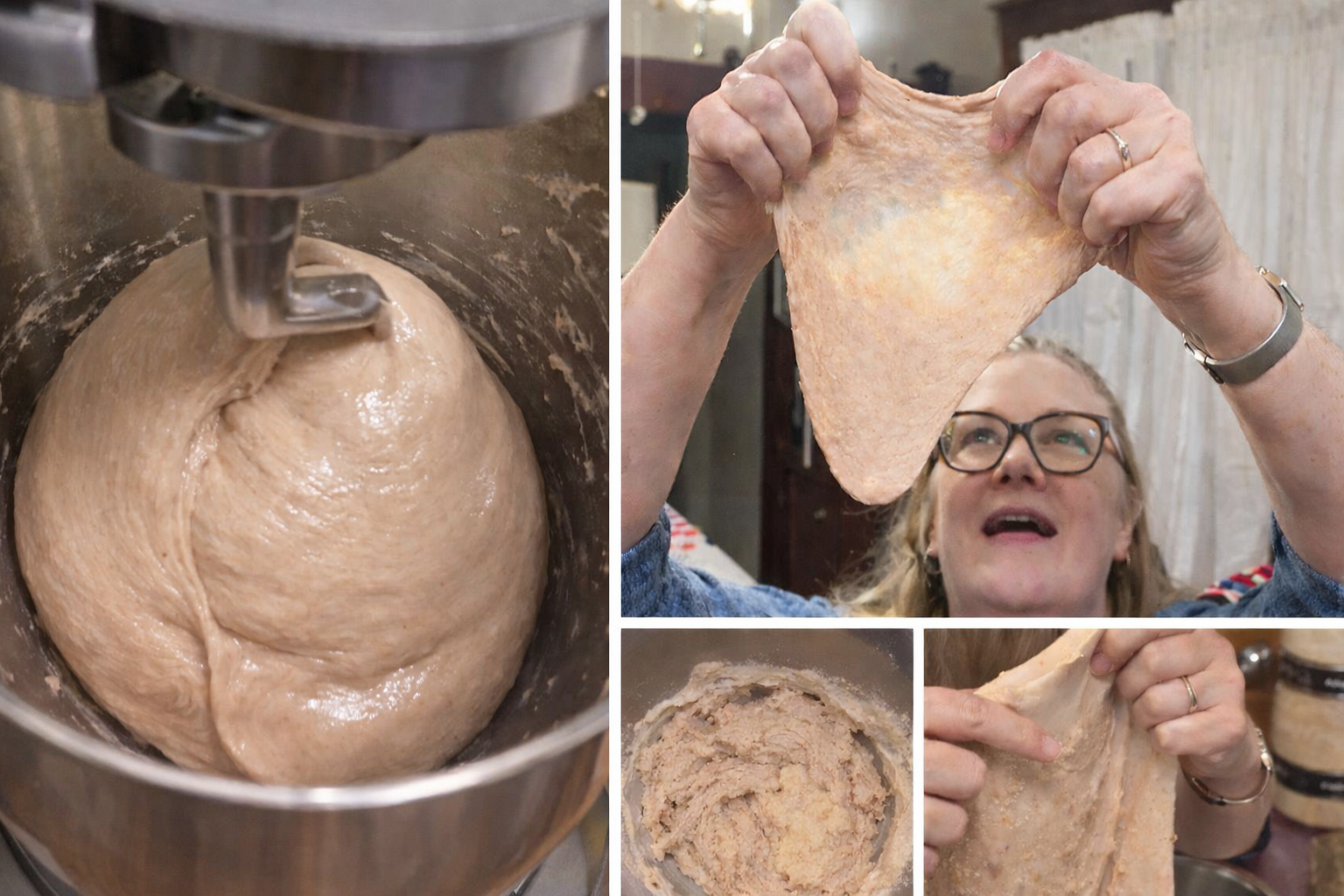
What High-Hydration Fresh Milled Dough Actually Does
At first, a properly hydrated fresh-milled dough doesn’t look like dough.
It looks:
loose
glossy
almost batter-like
This is normal.
And here’s the important part most people miss:
That extra water changes how kneading works.
Why You Can (and Should) Increase Mixer Speed
With higher hydration, fresh-milled dough behaves less like a stiff mass and more like something being aerated — similar to whipping eggs before they firm up.
That extra liquid:
reduces friction
protects gluten strands
allows faster alignment
So instead of babying the mixer, you can often:
start on low to combine
then increase speed sooner than you would with stiff dough
You’re not tearing gluten — you’re helping it organize.
As the dough develops:
it tightens
it pulls away from the bowl
it gains elasticity and strength
This transformation is one of the most satisfying moments in fresh milling — and it doesn’t happen at low hydration.
Mixer Matters: When You Can Skip a Rest (and When You Can’t)
I often skip a dough rest entirely — but only when the mixer can truly handle high-hydration fresh-milled dough without overheating it.
When a Rest Is Optional
If you’re using a top-mounted motor mixer with enough power and torque, you can often develop gluten fully by increasing speed instead of resting.
These mixers handle high hydration exceptionally well:
KitchenAid Professional series
Kenwood Titanium Major
Vintage Sunbeam Mixmaster (rotating bowl models with true dough hooks)
With these machines, I’ll often:
mix to combine
increase speed confidently
knead for several minutes straight
achieve a strong windowpane without a rest
The extra liquid keeps the dough cool and fluid while gluten aligns quickly.
A Quick Word on Mixer Performance
So far, the fastest and cleanest path to a beautiful windowpane I’ve seen — hands down — is with the Zacme 7.4 or 8.4 quart mixers. The combination of power, speed, and dough control is unmatched.
As for ultra-premium, plastic-heavy mixers sold at luxury prices?
I’ll pass. I’m not paying top dollar for a strong motor wrapped in weak parts.
The Takeaway
High hydration + fresh milled flour changes everything
Strong mixers can replace rest with speed
Bottom-motor mixers need cold ingredients and rest
Dough development is about heat control, not just time
When hydration, mixer choice, and technique align, fresh milled dough stops being unpredictable — and starts behaving like it finally understands what you’re asking it to do.
And yes…
everything really is better when you Just Mill It.
Before you go, you'll want to see these
Italian Bread BasesMaking Fresh Milled Sourdough BreadJoin our Online Community
Ready to ditch recipes and learn more about baking with fresh milled flour using methods and your imagination? Join my Fresh milled Flour Methods group. You can ask questions, share your wins, and more with an expectation of honesty and friendly interaction. I hear it’s the best place to be on Facebook.