
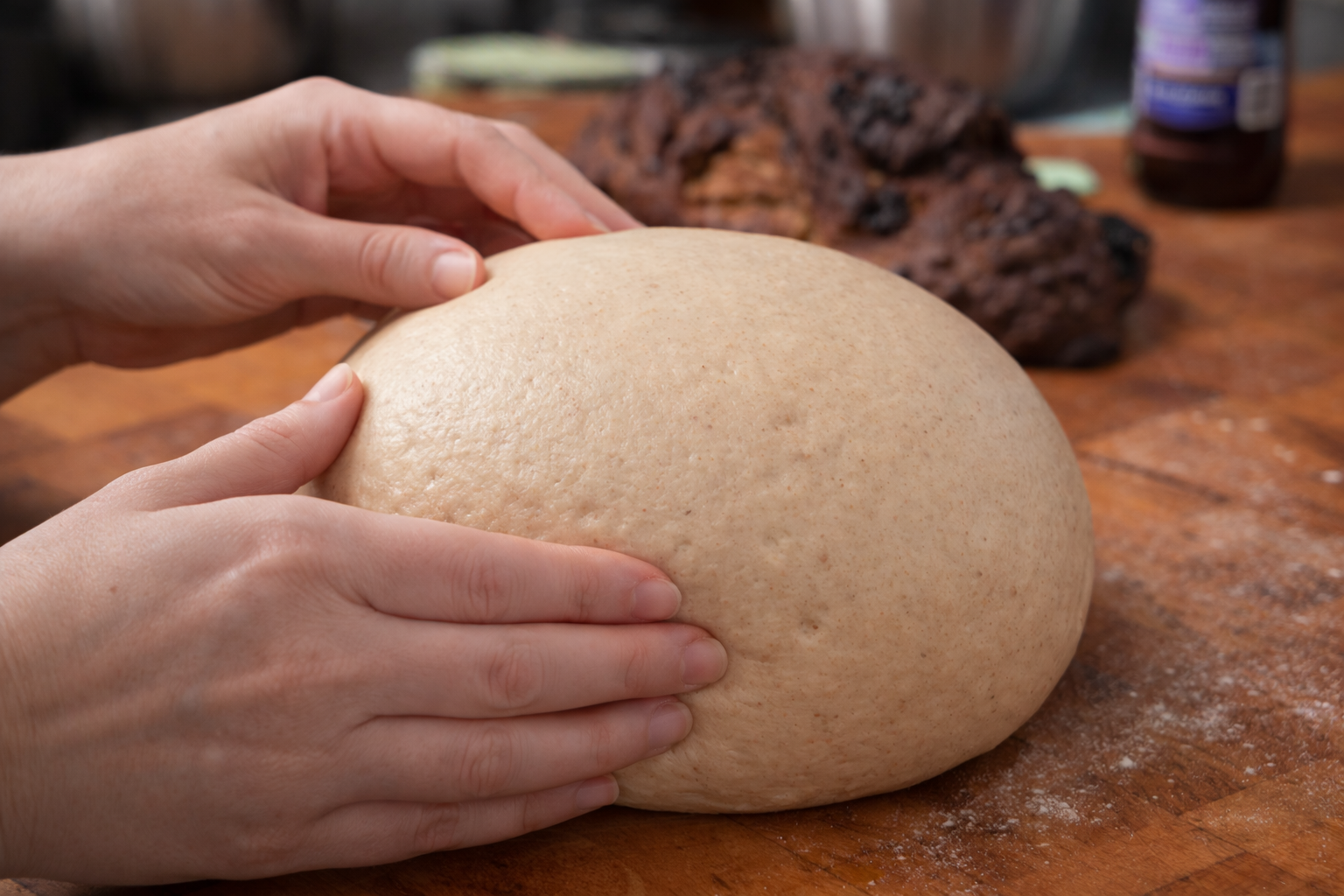
Shaping Bread Dough (Fresh Milled Flour)
After the dough has been scaled, it’s time to shape it into a loaf, rolls, or whatever you’re baking.
Shaping is where we turn a dough “blob” into a dough that rises in a controlled, predictable way. The goal is to create a smooth surface with tension, while keeping the seam on the bottom. That tension is what helps your dough rise up instead of spreading out.
If you ever feel like your bread “went wide instead of tall,” shaping is usually the fix.
Before You Shape: Quick Checklist
Before shaping, make sure your dough has completed its first rise:
It has fermented enough to feel lighter and more elastic
It isn’t tearing easily
It feels like it has some strength when you handle it
📘 If you need the full process context, start here:
Fresh Milled Bread Method
Set Yourself Up for Success
Choose one of these options depending on your dough:
Light flour on the counter (good for medium hydration doughs)
A lightly oiled surface (often better for higher hydration doughs)
A bench scraper to help you lift and tighten the dough without tearing it
If the dough is sticky, use:
lightly wet hands, or
lightly floured hands, or
lightly oiled hands (usually works best for lower hydration dough)
The goal is to prevent sticking without drying the dough out.
The Most Important Rule: Seam Side Down
No matter what shape you’re making, finish with the seam on the bottom.
This keeps your smooth surface tight and uninterrupted so the dough rises evenly. If the seam is on top, the dough will split in random places instead of expanding where you want it to.
Shaping a Sandwich Loaf (Pan Loaf)
This is the shaping method most people need first.
Gently press the dough into a rectangle
Fold the top third down, then the bottom third up (like a letter)
Roll it up into a log, tightening slightly as you roll
Pinch the seam closed
Place into a greased or parchment lined pan seam-side down
If the dough is fighting you, let it rest for 5–10 minutes and try again. Sometimes the gluten just needs a breather.
Shaping Rolls (Smooth Tops + Even Baking)
To shape rolls, you’re trying to create a smooth top with tension.
Take one dough piece
Tuck the edges under toward the center
Flip seam-side down
Cup your hand around it and “drag” it gently on the counter to tighten the surface
If you’re making rolls for a special purpose (burger buns, hot dog rolls, hoagies), shape them into that form after you’ve created a tight ball first - also known as flattening them.
Round Loaf (Boule)
A boule is a round, rustic loaf.
Press the dough into a rough circle
Fold edges toward the center all the way around
Flip seam-side down
Tighten the surface by gently pulling the dough toward you as it rotates
Use this for rustic loaves and sourdough-style shapes.
Oblong Loaf (Batard)
A batard is an oval loaf, great for a balanced crust-to-crumb ratio.
Press dough into a rectangle
Fold the sides inward and roll into a log
Taper the ends slightly
Seal the seam and set seam-side down
High Hydration Dough (Extra Tips)
High hydration dough often needs a little extra help holding shape.
Two things that help a lot:
shaping with a lightly oiled surface
using a proofing basket (banneton) or a bowl lined with a floured towel
The dough still needs surface tension — it just needs a supportive place to rest while it proofs.
Enriched Dough (Extra Tips)
Enriched dough (eggs, butter/oil, sugar, milk) is usually softer and can tear if rushed.
Use gentle shaping
Avoid adding lots of flour during shaping
Work efficiently, because it warms quickly
Enriched dough benefits from good tension, but it usually requires a lighter touch.
Pan Prep (So Your Dough Doesn’t Stick)
Once your dough is shaped, place it into a greased pan, a pan lined with parchment, or line it with a silicone bread sling/liner.
Some pans have a silicone or nonstick coating and may not require parchment or greasing as long as the coating is intact.
To protect coated pans:
hand-wash only
don’t use abrasive scrubbers
avoid metal tools
If dough needs help releasing from a pan, use a silicone spatula (no metal, no hard plastic).
What’s Next
Once your dough is shaped, it’s time for the second rise:
Join our Online Community
Ready to ditch recipes and learn more about baking with fresh milled flour using methods and your imagination? Join my Fresh milled Flour Methods group. You can ask questions, share your wins, and more with an expectation of honesty and friendly interaction. I hear it’s the best place to be on Facebook.