
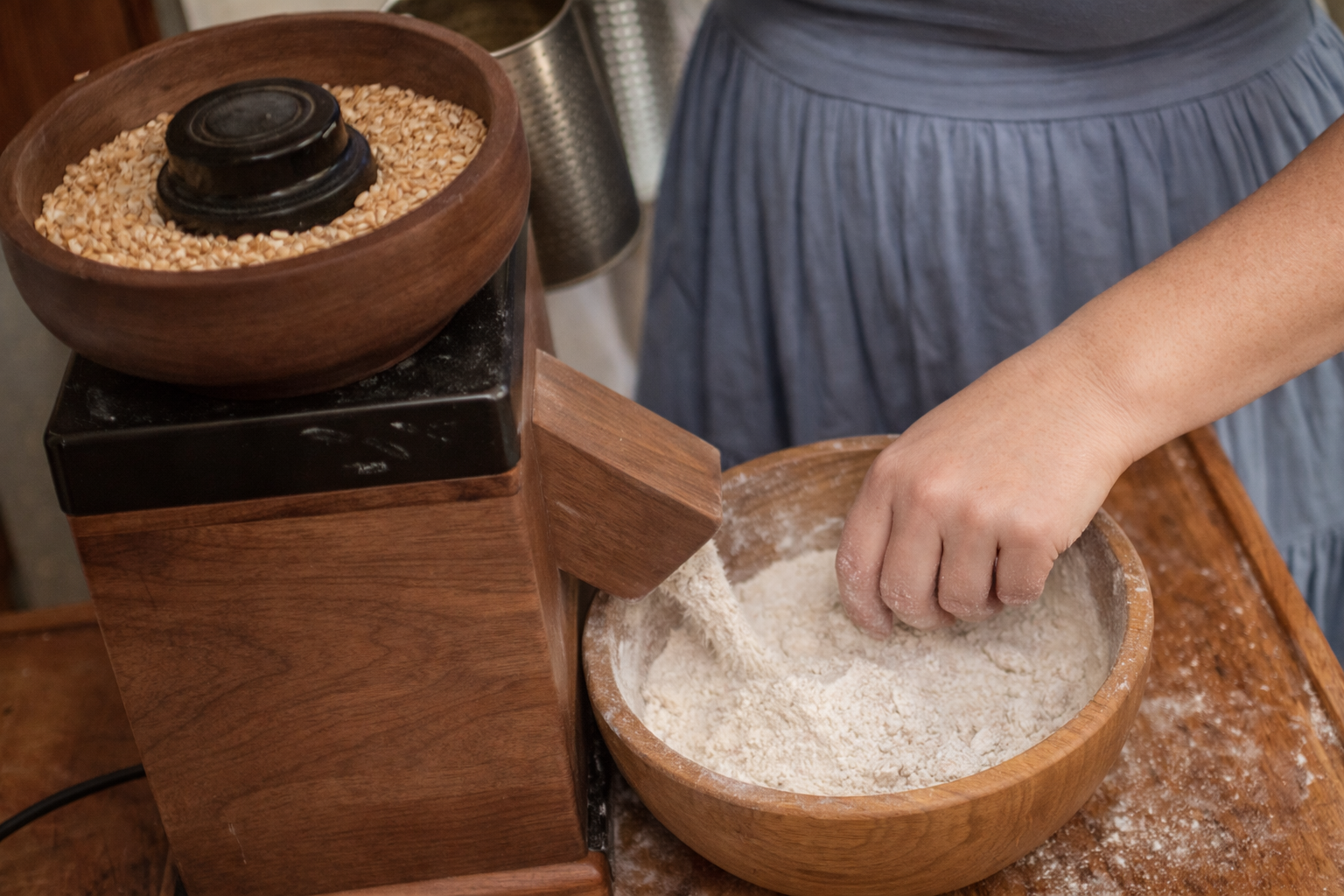
How to Make Bread Flour (and More) at Home
Using Freshly Milled Whole Grains
Your best option is always milling grains by category, based on what you’re baking — not chasing flour labels.
That said, sometimes you’ll want to translate a legacy recipe that calls for bread flour, cake flour, or all-purpose flour.
This guide shows you how to do that with fresh-milled flour — without losing the nutrition, flavor, or structure that makes home milling worth it in the first place.
👉 If you haven’t already, start here:
Grains by Category → https://justmillit.com/grains-by-category/
First, a Mindset Shift (This Matters)
Commercial flour names exist because:
the bran and germ are removed
the flour is standardized for shelf life
additives and bleaching agents are used to force consistency
When you mill at home, you’re working with the whole grain, so instead of copying labels, you choose grains based on function.
Think in terms of:
Bread
Pastries
Pasta
Everything else is a variation.
How to Make “Bread Flour” at Home
Commercial bread flour = hard wheat with the bran and germ removed.
Fresh-milled bread flour = hard grains, whole and intact.
Mill:
Hard white wheat
Hard red wheat
Fresh-milled bread flour has more absorption, more flavor, and more nutrition than store-bought bread flour — which is why recipes must be adjusted accordingly (and why your base recipes already are).
How to Make Pastry Flour / Cake Flour
Commercial pastry flour is usually:
lower protein flour
often have cornstarch added
You can skip all of that.
Mill:
Soft white wheat
Soft red wheat
This can also be made with ancient grains like:
Spelt
Barley
Rye
Gluten-free grains (for pastries)
These grains naturally produce a tender crumb without additives.
How to Make All-Purpose Flour (and Why I Rarely Do)
All-purpose flour is a compromise flour — meant to work “okay” for everything.
When milling at home, it’s usually better to:
choose hard grains for bread
choose soft grains for pastries
skip AP flour altogether
If you must approximate it:
Mill:
A blend of hard + soft grains
Start with 2 parts hard wheat : 1 part soft wheat
But again — category-based milling gives better results.
If you want an ancient grains version, try milling Einkhorn for anything calling for all purpose flour.
How to Make Self-Rising Flour
Self-rising flour is simply soft flour + baking powder.
Mill:
Soft wheat, spelt, barley, or rye
Then add:
1 teaspoon baking powder per cup (125 g) of flour
Use this for quick breads, biscuits, and muffins.
How to Make Semolina Flour
Semolina is coarsely milled durum wheat, known for its golden color and firm bite.
Mill:
Durum wheat
For an ancient grains version:
Khorasan (Kamut), Emmer, or a blend of the two
Grind slightly finer than cornmeal
Ideal for pasta and some rustic breads.
How to Make Semola Flour (Twice-Milled Durum)
Semola is a finer version of semolina.
Mill:
Durum as fine as possible in your stone mill
For an ancient version:
Khorasan (Kamut), Emmer, or a blend of the two milled as fine as possible
Optional: sift and re-mill
It is not necessary to double mill durum for great pasta.
I mill it as fine as my stone mill allows and use it successfully for both extruded and hand-shaped pasta, including angel hair.
How to Make Chickpea Flour
Mill:
Dried chickpeas
⚠️ Important:
Only mill chickpeas if your mill is rated for them
Stone mills like Mockmill and NutriMill Harvest can handle chickpeas, but always confirm with the manufacturer
How to Make Gluten-Free Flour
Mill:
Sorghum
Quinoa
Buckwheat
Rice
Amaranth
Millet
Avoid oily seeds in stone mills:
Hemp, chia, flax → use a blender or steel burr mill
⚠️ Celiac Safety Warning
If you have Celiac disease:
you must use a dedicated gluten-free mill
never mill GF grains in a mill that has processed gluten
Can I Buy Fresh Whole Grain Flour?
It’s not ideal — but if needed, buy from a local mill offering 100% extraction flour, shipped fresh with storage instructions.
A good example:
Janie’s Mill → https://www.janiesmill.com/products/whole-kernel-bread-flour
Follow storage instructions carefully to preserve nutrition.
How Much Grain Makes 1 Cup of Flour?
1 cup flour = 120–130 g
I use 125 g per cup
Grain weighs the same whole or milled — only volume changes.
That’s why I mill and bake by weight, not cups.
👉 Full breakdown here:
https://justmillit.com/how-much-grain-do-i-need-for-1-cup-of-flour/
The Big Picture
This site isn’t about chasing flour labels.
It’s about:
methods
base recipes
intentional variations
Once you understand that framework, recipes stop being rules — and start being tools.
Sometimes the simplest answer really is the best one.
I’m Dr. Mel — reminding you that baking gets easier when you Just Mill It.
Join our Online Community
Ready to ditch recipes and learn more about baking with fresh milled flour using methods and your imagination? Join my Fresh milled Flour Methods group. You can ask questions, share your wins, and more with an expectation of honesty and friendly interaction. I hear it’s the best place to be on Facebook.